


5 guitar-driven tracks from U2
A list of guitar-driven tracks from U2 that will make you see the band from another angle. One, Where The Streets Have No Name, Pride (In The Name Of Love), Bullet The Blue Sky, The Fly, Beautiful Day.
By Dimitris (Bari) Polyzois
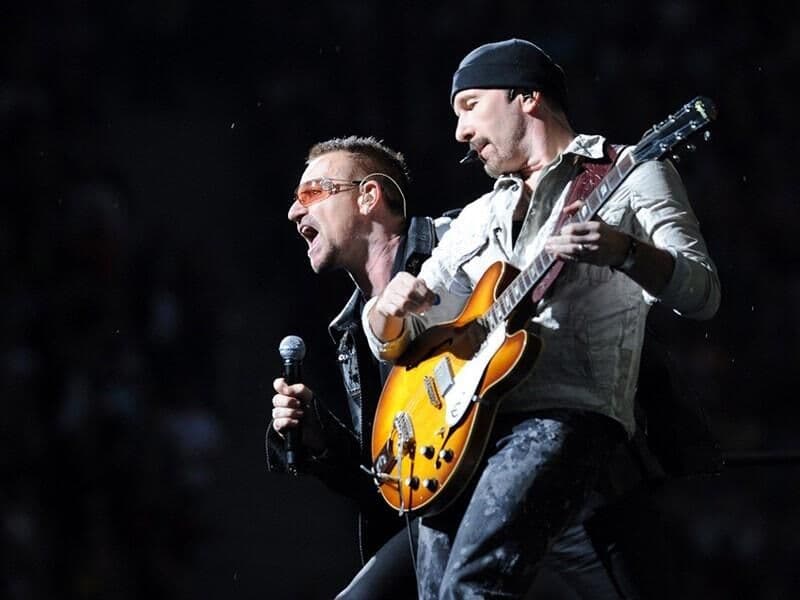
On the 40th anniversary of the release of their debut album Boy, there's been a steady flow of transition. The U2 anthems were built around The Edge's uniquely creative, pioneering guitar approach. Here we'll look at 5 selected guitar-driven tracks from U2, the famous Irish band.
But his creativity isn't limited to arena-riffs. The following picks are five lesser-known but impressive examples of his talent, well worth discovering.
For a player who's been literally branded a repeat offender for peddling delay, these songs are quite different from one another. Both U2 in general and The Edge in particular have been underrated over the years for the variety in their output. So it's strange to think that, for instance, I Threw A Brick Through A Window and Miami are the work of the same songwriters.
The same range applies to the guitar playing too. We hope this small collection will convince even the biggest skeptic that there's a lot more that The Edge brings to the table than just delay on the band's well-known mega hits.
1. A Sort Of Homecoming
The confrontational theme of the 1983 album War called for a violent and stripped-down approach to the sound. This is evident in the martial snare of Sunday Bloody Sunday, the intense arpeggio riff and the track's dynamic solo.
So they wouldn't be pigeonholed as angry protest rockers, while working on The Unforgettable Fire the band teamed up with Brian Eno and Daniel Lanois. The Edge bought two Korg SDD-3000 digital delay units and they recorded in a spooky castle to deliberately explore a more refined sound.
The opening of A Sort Of Homecoming sets out the new environment and the new sonic landscape. Edge still plays chord arpeggios in beautiful fashion, but now they ring out amid an otherworldly reverb and delay. His playing on the track is more energetic and organic than ever. The song's intro combines muted string scrapes, squeals and rapid finger slides. All of this using delay and heavy sus4 and open chords.
The difference from before is that on this album, his role changed to allow him to create layered guitar sounds to build atmosphere. As opposed to the standalone riffs that grab attention and form the entire song. The result, especially on A Sort Of Homecoming, is a rich, shaped soundscape that reveals something new on almost every listen. It's a huge leap forward for The Edge as a sonic mastermind.
2. Love Is Blindness
Achtung Baby is a noisy, war-torn record. Its closing track, though, offers a raw and introspective finale. It was written on piano by Bono and originally intended for Nina Simone. After playing it together, they decided to keep it for themselves. They built its mood around an organ and a bass with tremolo.
Throughout, Edge hisses with volume swells of modulated distortion. He lingers on single notes to create a maudlin feel and a keening effect through their repetition.
When it comes to the solo, though, it electrifies the dark atmosphere with a fierce storm of lightning-fast guitar soloing that comes from a completely different place. It's shattering, angry, and completely at odds with the otherwise subdued mood.
One of the "brainwave" ideas during the session was to distract the musicians during their solos to produce less predictable results. "I didn't enjoy that idea at all," Edge told the Times. "So I stopped and pretty much told them to leave me alone. Then I put down the solo we ended up using and it's one of my favourites."
While making the album, the guitarist was going through a divorce and perhaps that was on his mind. That's why he seems to use "wounded" tremolo picking and records using the grit of a small amp. In the end, he didn't even escape breaking a string. "He kept playing harder and harder," Bono recalled. "Another string broke. And he's usually got such a light touch, he's so gentle. All this left him with a kind of rage."
"He's usually so gentle. All this left him with a kind of rage."
3. Gone
Continuing with the guitar-driven tracks from U2!
From small amps and tremolo picking to monster effects riffery. The 1997 album Pop was an ambitious extension of its predecessors' recent experiments. It saw the band team up with producers Flood, Howie B and Steve Osborne to fold samples, loops and programming from the world of electronica into the U2 sound.
The album ultimately split opinion between critics and fans. The Edge, at least, took the opportunity to explore the new possibilities the setting offered him. Among these were the use of filtering and repeating parts of his own guitar. The result of some of this is the powerful sound dominating Gone.
This setup got nicknamed the "747 sound" for its sonic bloom and jet-like timbre. Flood described it as a semi-hollowbody Epiphone or Gretsch into a Korg SDD delay with plenty of feedback. All of that was fed into a Fuzz Face and a second fuzz pedal, plus a DigiTech Whammy set to the +2 octave setting. The result is all those controlled sweeps. All told, the guitar spans a range of five octaves. "The way he's built it," Flood told Guitar Player in 1997, "makes the guitar start feeding back in a controlled way that sounds totally out of control."
4. Until The End Of The World
U2 have contributed to film soundtracks a few times over the years. In 1986, Edge created the mostly instrumental soundtrack for Captive. This remains his only solo album. In 1995, U2 contributed Hold Me, Thrill Me, Kiss Me, Kill Me to the soundtrack of the film Batman Forever. That same year, the whole band collaborated as Passengers with Brian Eno on Original Soundtracks 1. This was a series of "visual music" soundtracking explorations for (mostly) imaginary films.
Having agreed to compose a song for Wim Wenders's 1991 sci-fi film Until The End Of The World, Edge revisited an old demo called Fat Boy. This had a promising riff from Bono. He strapped on a capo and threw every trick from his considerable arsenal at it.
Until The End Of The World is one of the most guitar-driven tracks from U2. Bono narrates the song from the perspective of Judas Iscariot betraying Jesus, and after a tormented Whammy intro, Edge responds with an unholy composition of distorted tones and clusters of arpeggios, octave riffs and harmonics. All of this within a mean and vengeful solo that combines piercing high notes with descending string slides and legato. All of it wrapped in the recording by swells of reversed guitar sounds. It's one of his most towering and creative recordings.
5. Unknown Caller
And the list of guitar-driven tracks from U2 closes with Unknown Caller.
By the time of 2009's No Line On The Horizon, Edge had become a player guided by production sensibility. Unknown Caller is a transmission of beautifully judicious guitar parts building toward a refined rock statement.
Doubled guitar tracks on both sides of a stereo mix are a reliable way to create space and depth. Here they offer a great way to hear Edge's individual guitar parts stand out in spectacular fashion. Delicate acoustic touches are used to accent the phrasing. Fuzzy single notes follow the bass line to build up tension. Edge contrasts volume swells against compressed passages, creating a dynamic effect.
The song's solo contains a middle section with odd parts for French horn and church organ. It's been described by guitar tech Dallas Schoo as "one of Edge's most significant solos of his life. You won't hear better than this on any other song."
Unusually clean-cut for an Edge creation, it was celebrated in its entirety from the track's original demo. A one-take recording made while the band improvised in a makeshift studio setup they built in a rented Riad in Fez, Morocco.