


5 guitar tracks from 'The Bealtes'
The guitar tracks we picked out from The Beatles. Even though The Beatles broke up 50 years ago, their influence on popular music remains as strong as ever.
By Dimitris (Bari) Polyzois
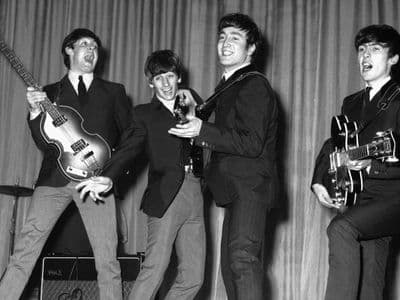
Having the luxury of three very different guitarists with very different playing approaches and writing styles, it's impossible to pick just five guitar songs. While we usually single out artists like Elvis Presley or Jimi Hendrix, there are plenty of hidden guitar gems in The Beatles too. Tracks that guitarists who aren't well-versed in the band tend to overlook. Let's take a look at some of them.
In many ways, Paul McCartney was the most complete musician in the group, and perhaps even its best guitarist. He was the one who came up with many of the riffs and even played some of the most memorable solos. Tracks like Taxman (Revolver), Ticket To Ride and the excellent riff on the Epiphone Casino in Paperback Writer.
George Harrison was the band's most thoughtful player, but when the moment called for it, he could really play. Check out his acoustic playing on Here Comes The Sun and of course the legendary solo on Something from Abbey Road. Players like Joe Satriani cite it as a reference.
Alongside his astonishing songwriting abilities, John Lennon's role in the band was officially that of "rhythm guitarist". But John stepped forward on many of the band's biggest tracks, like Get Back. Still, we thought we'd dig deeper into their catalogue to uncover five tracks you might not be so familiar with. In each track, the contribution of John, Paul or George stands out. Many feature more than one Beatle playing guitar up front.
1. All My Loving (With The Beatles, 1963)
This song was never a single in the UK or the US. It certainly helped the LP With The Beatles top the charts around the world, though. Paul's vocals and bass let the song drive along at a steady tempo.
But take a look at Lennon's superb guitar work: the relentless triplets he plays on his short-scale Rickenbacker 325 are the song's powerful engine. His knowledge and use of different chord inversions meant he stayed in one area of the neck, rather than worrying about his fretting hand jumping up and down.
He was clearly pleased with his work, as he later described it as "a beautiful little bit of guitar". Harrison wasn't to be outdone. His concise, Nashville-inspired solo offers the perfect wrapping for the song's exterior.
Following a simplified chord progression written specifically for the solo, George used a mix of single notes and double stops. In doing so, he creates a short but deceptively clever and highly memorable break.
2. And Your Bird Can Sing (Revolver and Yesterday And Today, 1966)
Another capo-based song, And Your Bird Can Sing is written in E. However, the rhythm guitars, played by Lennon, once again use a "D"-shaped chord at fret 2. What's interesting is that John plays strokes, one strum per beat, on each chord. What really sets it apart, though, are the lead guitars, as And Your Bird… was one of the first pop or rock songs to feature harmony guitars. The Shadows' 1961 instrumental Nivram is one of the few that came before it.
Harrison and McCartney worked out the parts together and played them on matching Epiphone Casino guitars with powerful P-90 pickups. Although Lennon later dismissed the song as puerile, it stands as a clever and intricate piece of guitar work.
George and Paul harmonise beautifully over the E major scale, mostly in 3rds, during the song's intro. They also repeat an extended version of the same part in the middle and at the end.
It was one of the first pop or rock songs to feature harmony guitars
In the middle section, the guitars play arpeggios of the same chords. Eagles guitarist Joe Walsh was convinced that Harrison had played that exact passage in one take. Joe spent hours learning to play it that way, and it was only later, when he started working with Beatles drummer Ringo Starr, that he discovered the truth. The guitar work on this track is sheer genius.
3. Happiness Is A Warm Gun (The Beatles, 1968)
It's well documented that Lennon learned fingerpicking from Scottish folk singer-songwriter Donovan. This happened during the band's 1968 visit to Rishikesh in India, where they practised transcendental meditation with Maharishi Mahesh Yogi. Lennon picked up the technique right away and would go on to use it on several tracks on the self-titled release known as the White Album.
These include the track Hapiness Is A Warm Gun. Split it into four distinct sections. Start with the dreamy first verse that moves from Bb minor 7 and Bb minor 6, to F minor/add9 and F minor. John used Donovan's fingerpicking approach, but on electric guitar, with a hint of fuzz tone. This transforms into a bluesy section where the key shifts to Bb7. George, who had helped John with the song's tricky time signatures, switches up this section with one of his most distinctive solos.
It's played on the low strings and features bends and heavy vibrato. It sounds strange and makes us wonder if the guitars were tuned a semitone down. After a riffy "rock 'n' roll" section, the melody carries into the final refrain "Happiness is a warm gun", with perhaps Lennon's finest vocals and excellent three-part harmonies. Paul is said to have called it the best thing he'd ever heard. Guitar-wise, it's as strange as it is wonderful. Overall, the band considered it the White Album's watermark.
4. The End (Medley, Abbey Road, 1969)
While the dramatic three-guitarist solo during Abbey Road's climactic finale defines the record, the much more subtle and exceptionally beautiful guitar solo in The End itself is a mini work of art by Harrison.
While producer George Martin threw a 30-piece orchestra onto this track that lasted about half a minute or so, and McCartney played piano and sang the immortal couplet, "And in the end the love you take, is equal to the love you make", George came up with a beautiful solo. With clean, mini sweeps and intense bends. His notes follow Paul's chord sequence perfectly, offering a more subtle and refined finale to the very last track the four Beatles ever recorded together. Guitar-wise, it stands as a perfect closing statement on a wonderful album.
5. Don't Let Me Down (Let It Be sessions, 1969)
We close out the list with a fairly harmonic and distinctive track. It was written by John as an expression of his love for Yoko Ono. The song is heartfelt and passionate.
On it, Lennon and McCartney (mainly) share vocal duties. The latter is on bass, while Lennon and Harrison are on guitars. Listening to it, you can feel the many layers of guitar parts. The melody weaves with the rhythm in a way that recalls the Hendrix style. It's a fun-to-play track with plenty of quirks to explore and discover.
For more information on The Beatles, you can check out the official page .