


6 Guitarists Who Play With Slide
A tribute to 6 guitarists who play with Slide, using fresh and distinctive approaches. It's impossible to know the exact details.
By Dimitris (Bari) Polyzois
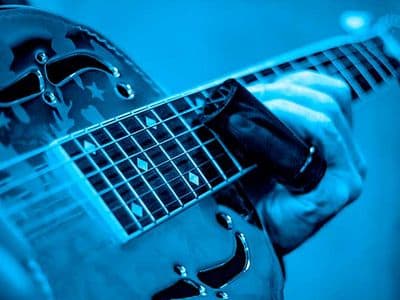
Even so, at some point near the beginning of the 20th century, some random musician in the Mississippi Delta must have rubbed the strings of a guitar with a knife, a glass bottle, or some other hard object. In doing so, he discovered that the instrument could produce a tremendous vocal-like sound. Around the same time, Hawaiian musician Joseph Kekuku pioneered the steel guitar. Using a steel bar on the strings, he achieved a similar effect. This is more or less how we could say the concept of slide guitar began.
The Origins of the Slide
While the origins may be murky, it's clear that slide guitar became popular among blues guitarists. Artists like Robert Johnson and Son House, and Hawaiian musicians like Sol Hoopii in the first half of the 20th century, used this technique. Not to mention country-and-western and bluegrass, with representative musicians like Noel Boggs and Leon McAuliffe. The sound of an open-tuned instrument played with a slide is inextricably linked to these styles and their offshoots. More broadly, it's linked to all of popular American music.
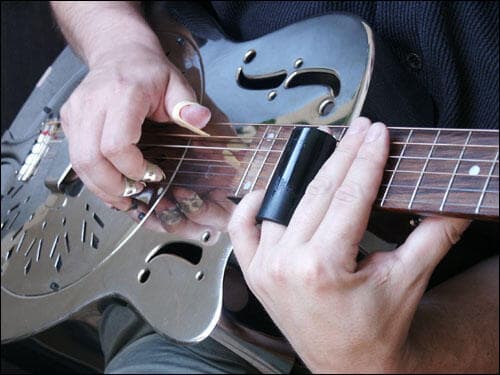
But over the century since slide guitar became common practice, the technique has been used in almost any imaginable context. From rock to jazz and beyond. It has also been used on a huge range of instruments. From acoustic and electric guitar, to resonator guitar, lap and pedal steel, and many other stringed instruments. The six musicians presented here show just how wide a range of concepts, sounds, and curves can be brought to life with the slide technique. So let's meet Harry Manx, Steve Dawson, Doug Wamble, Ross Hammond, Marisa Anderson and Debashish Bhattacharya.
Harry Manx
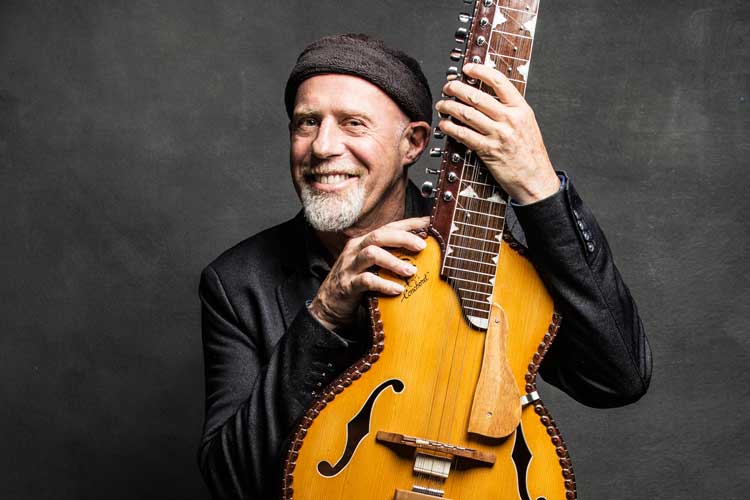
Harry Manx was a young teenager when he bought his first blues album — Johnny Winter's The Progressive Blues Experiment. He immediately fell in love with the sound of slide guitar. Eventually he managed to tune a guitar to open D. He placed it on his lap and taught himself using a French wrench!
"Back in those days [in the late 1960s and early '70s], there really wasn't any instructional material available. So I had to work it out by ear," says Manx. "Listening to Ry Cooder, David Lindley and Jerry Douglas, I was able to hear the possibilities of the sound."
He managed to teach himself using a French wrench
Manx, who dropped out of high school at 14, says his education came from his job as a soundman. Working at the El Mocambo blues club in Toronto, he got to see the great blues players like Muddy Waters and Willie Dixon up close. He started his life as a professional musician in Europe in the mid-1970s. In this way, he completed this journey in the late 1990s in Japan.
Manx, now 55 years old, says, "I spent a lot of time playing other people's songs and making a decent living. Then, at some point in my 30s, I realized I really wanted to play more slide. My first attempts were pretty disappointing, but after practicing three hours a day, I quickly improved. With my right hand, I started developing a kind of slap that would give the rhythm. At the same time, I could see my audience out on the street getting more into the groove."
My first attempts were pretty disappointing, but after practicing three hours a day, I quickly improved
In the 1980s, Manx traveled frequently between India and Japan. One day while walking around the latter country, he followed some interesting sounds into a small record store. He learned he was listening to Indian classical music. "What an awakening I had that day," says Manx. "When I got back to India, I went straight to Rajasthan to find Vishwa Mohan Bhatt, the creator of the mohan veena (a guitar with 20 strings). I arrived at his doorstep late at night and laid my life at his feet. He took me on as a student and gave me a veena. What a joy and a blessing it was to be near that mountain of talent and kindness that is Vishwa."
Although Manx admits he never became a great Indian classical musician, he found a way to weave the feeling and depth of that music into everything he does today. Including, in fact, his latest album, Hell Bound for Heaven (Stony Plain), with Canadian multi-instrumentalist Steve Marriner. Through his travels, both literal and figurative, Manx arrived at a unique slide-playing style that carries traits of both East and West. "My blues is a bit Indian and my Indian is a bit blues," he says.
What He Uses
Manx's main instrument is a Taylor 710, which has been modified for lap-style playing. His tunings are D-based — either D A D F # A D (D major), D A D F A D (D minor) or D A D F # A C # (D major seventh). The guitar is fitted with a Sunrise pickup, which Manx runs into a Universal Audio preamp.
He also has a National Style 0. A Gold Tone model Banjitar six-string banjo (tuned to open C). And finally, a four-string cigar box instrument (tuned F F C F) built by luthier Grant Wickland. Manx uses acrylic nails on his hand, a Dunlop Lap Dawg bar and various sets of Elixir strings.
Steve Dawson
Growing up in Vancouver, British Columbia, in the 1980s, Steve Dawson enjoyed playing electric guitar in a typical rock band. He figured he'd become a serious musician and study jazz when he enrolled at Berklee College of Music in Boston. But things changed once he got there. "That's where I got seriously into acoustic guitar, as well as dobro, country music, bluegrass and fingerpicking," he says.
After college, Dawson worked with various bands. However, he grew tired of playing in loud bars where the crowd was less attentive. So he formed an acoustic duo, Zubot & Dawson, with fiddler Jesse Zubot. The duo toured the world and enjoyed considerable success, which Dawson has parlayed into a busy, multi-faceted career. Now based in Nashville, the guitarist splits his time between several pursuits. He serves as a sideman for musicians like Matt Andersen and Birds of Chicago. At the same time, he records and tours in support of his own music and works as a producer. As he puts it: "I work for whoever, as long as we can collaborate properly."
He figured he'd become a serious musician and study jazz
Dawson estimates that 80 percent of his work involves a slide. He plays both in conventional position and lap style on the Weissenborn. He also does a bit of pedal steel. Rather than a fully open tuning like E, D, G or A, he usually opts for double-drop D. In this tuning, strings 1 and 6 are tuned to D, since he finds this arrangement more practical. "It lets me play all the slide stuff I want," he explains, "while also getting through whole songs without playing slide at all."
Whether he's playing with slide or without, Dawson draws from a deep well of influences. The blues and rock canon generally. He's also been inspired by great guitarists like Doc Watson and Chet Atkins. But even by electric guitarists like Ry Cooder and David Lindley. These influences are evident on his latest album, Lucky Hand (Black Hen Music). "I've also studied Hawaiian music for a while and did some work with Bob Brozman, who showed me all kinds of things," says Dawson.
What He Uses
Dawson's live acoustic instrument is a 1990 Larrivée JV-05. A jumbo-body instrument, fitted with a Sunrise pickup. In the studio, Dawson turns to a 1955 Gibson J-50, a 1927 National Style O and a Martin OO-DB Jeff Tweedy signature model. He also uses a Celtic Cross Instruments Weissenborn. He often plugs into a Fender Deluxe amp and uses Strymon Flint, Catalinbread Belle Epoch, JHS SuperBolt and Dingtotone HZD Boost pedals. His guitars are strung with various sets of D'Addarios. He prefers a no-name glass slide for bottleneck and a Dunlop 925 Ergo bar for lap style.
Doug Wamble
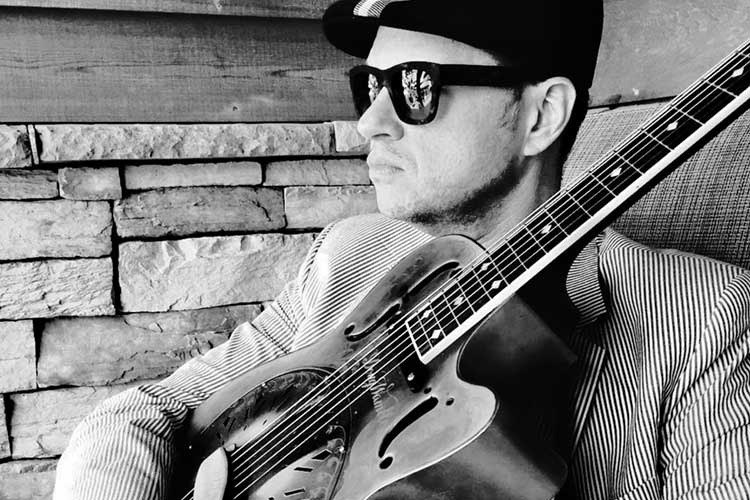
As a teenager in Memphis, Tennessee, in the mid-to-late 1990s, Doug Wamble was surrounded by old music. His mother was the house pianist at their Baptist church, and his grandfather was an amateur but devoted musician. He played gospel and country songs on his guitar at home. Wamble started out on clarinet. Seeing clips of the Benny Goodman Sextet on television, he was inspired by Goodman's guitarist, Charlie Christian. "That's what started it for me," says Wamble. "I picked up guitar and started playing jazz at the same time."
Wamble, who studied music at the University of North Florida and Northwestern University in Chicago, made the celebrated move to New York in 1997. Thanks to a chance connection with Wynton Marsalis, the trumpeter, composer and artistic director of Jazz at Lincoln Center, Wamble found work very quickly. Within a week he had a gig with Madeleine Peyroux and made his first recording as a sideman for Marsalis on the album Big Train. Wamble launched his solo career in 2003 with Country Libations. On it, he viewed jazz through a gospel-and-blues lens. That was an approach that characterized his work in general. "I've always been guided by a love of American roots music," he says.
"I've always been guided by a love of American roots music"
Wamble estimates he plays with slide about 60 percent of the time. He came to slide not by learning the work of the old blues masters, but by adapting the ways of great jazz players. "I knew of [the adventurous electric guitarist] David Tronzo from reading guitar magazines. But that was years before I actually heard him," says Wamble. "For me, it all started by trying to imitate the distinctive vibratos of Johnny Hodges and Sidney Bechet. I loved how they sounded."
Wonderful examples of slide playing can be found on Wamble's latest project – 9 for '19. A collection of nine albums released one per month from April to December 2019. On an earlier octet release of "Sleepytime" (the old standard "When It's Sleepy Time Down South"), Wamble opens with a flawless solo over a warm horn arrangement. "Slide lets a guitarist be the bridge between the solo and the rhythm section," he says. "I can play solo, play melodic lines, or drop back into the rhythm. I love that freedom."
What He Uses
For slide guitar, Wamble prefers a Mule Resophonic tricone or a 1929 National Triolian. He uses a mix of D'Addario strings, Planet Waves Nylpro, and a reversible Shubb AXYS slide.
Ross Hammond
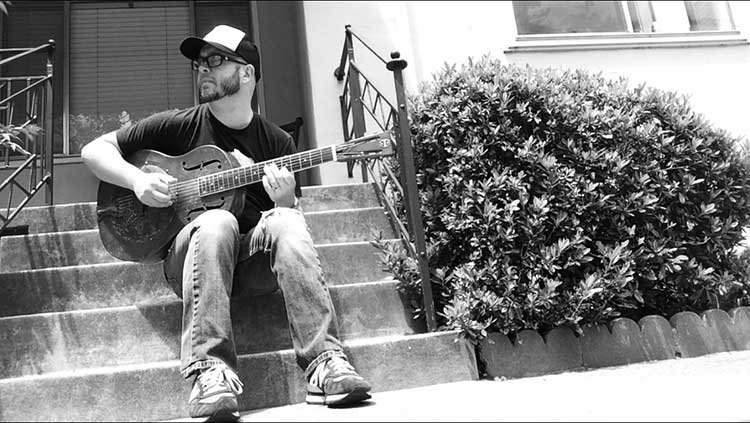
Ross Hammond hails from Lexington, Kentucky. He had a familiar musical path in his formative years. As a teenager, he mostly played rock and blues on electric guitar. While attending California State University, Sacramento in the mid-1990s, he got into jazz and improvisation. Around the same time, he started working at Fifth String Music, a shop specializing in acoustic instruments that served as a hub for the local folk and blues scenes.
"There were a lot of great players who either taught there or hung around regularly. It was, maybe, the best guitar education anyone could get," says Hammond.
After college, Hammond spent a decade playing electric guitar and working to build an improv scene in the Sacramento area. But when he became a father in 2010, he turned his focus to acoustic. He concentrated on playing blues and raga (the framework for melodic improvisation in Indian classical music). He used slide and lap style. "After I became a dad, I wanted to be home more, so I started playing solo. I felt like it was time to unplug," he says. "It felt like the right way to play the blues."
"There were a lot of great players who either taught there or hung around regularly. It was, maybe, the best guitar education anyone could get"
These days Hammond plays acoustic slide almost exclusively. He hasn't lost his taste for improvisation and tends to avoid composed pieces, instead exploring spontaneous variations on short pre-set themes. "Slide is great for that," he says. "Raga and improvised music lend themselves to composing on the fly and trusting yourself. It also trains your ears. And slide is the closest thing I've found on guitar to the human voice. So it's very easy to get lost in the sounds it makes and then wake up about 30 minutes later."
What He Uses
Hammond's main acoustic guitar is a Pleinview Guitars Small Jumbo, built by luthier Raymond Morin. Hammond also plays a baritone lap resonator and a 12-string lap resonator, from Turkey Tone (luthier Chris Harvey). He also uses a Republic resonator guitar for slide. For fingerpicking, Hammond uses Dunlop and Acri fingerpicks and Fred Kelly Slick Pick thumbpicks. For flatpicking, he uses a Dunlop Gator pick (2.00 mm). On acoustic guitar he prefers a colored brass Dunlop 228, opting for a Dunlop Lap Dawg on steel guitar. When needed, he amplifies his instruments using a Lace Ultra Slim Acoustic Sensor pickup and plugging into a ZT Lunchbox or Lunchbox Acoustic amp.
Marisa Anderson
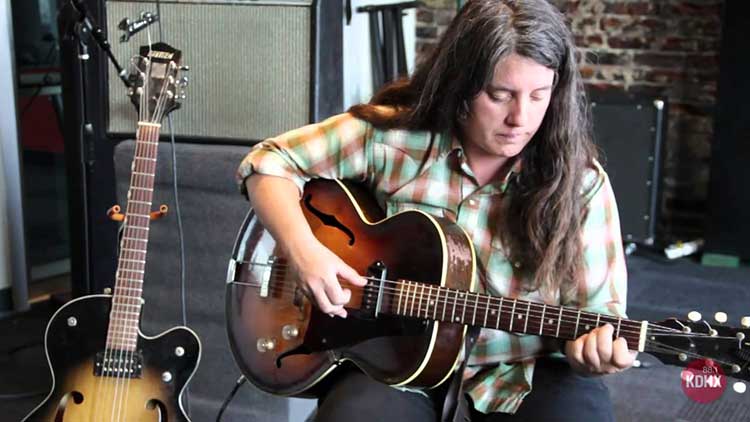
Marisa Anderson may spend less time on slide than the other guitarists featured here. She estimates that about a third of her current work uses it. She plays acoustic about as often as electric. But a deep connection to acoustic slide guitar is evident in her work, which is always earthy and occasionally strange. "I like the notes between the notes. The journey of moving from one known place to another by traveling through sonic space. It's literal and physical, moving an object along the neck of the guitar," she says.
Anderson, based in Portland, Oregon, started playing guitar in the early 1980s, when she was about ten. She started with classical guitar and later studied with guitarist Nina Gerber, who taught her to improvise. That became a big part of her music. "Traditional American music is an improvised music. Common themes and characters, phrases and melodic fragments show up throughout American music," says Anderson. "The way I approach these common elements is similar to how a jazz player might draw on the jazz tradition to create new work or cover a standard."
"Traditional American music is an improvised music"
Anderson also enjoys some of the improvisational details that come as byproducts of playing with slide. Such elements can be heard on the track "Lament" from her latest album, Cloud Corner (Thrill Jockey). "I love the incidental noises and transitions that come with playing slide. I like that it lets me shift my timing as I move from one position to another," she says. "When I play slide, I can't control everything, unlike with conventional playing. I feel like some wonderful moments happen when
I respond to the unexpected."
What She Uses
Anderson's main slide guitars include a 1930s Dobro Model 27, a Gibson ES-339 and a 1960s Fender Stratocaster. She also has a Dickerson lap steel and a Sho-Bud single-neck pedal steel. She makes her own slides using the necks of wine bottles. Finally, she uses a mix of D'Addario strings.
Debashish Bhattacharya
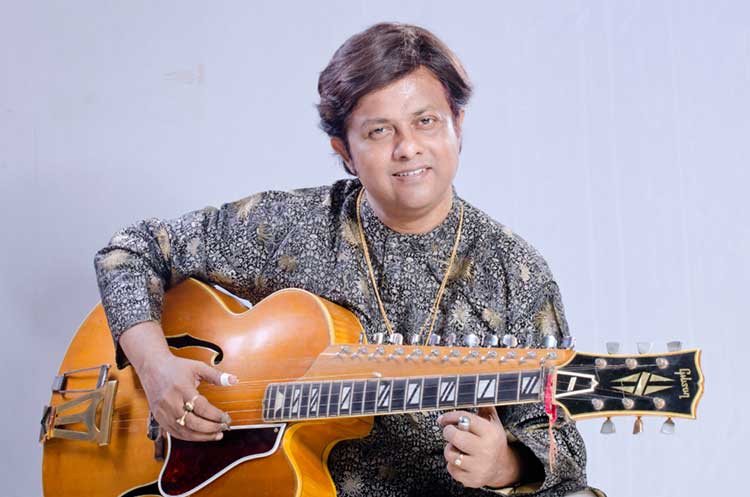
As the son of Indian classical singers, Debashish Bhattacharya may have been destined for musical greatness. But he was very young — just three years old, to be exact — when he received his first guitar and learned to play. "I was playing around our village orchard one afternoon when my mom handed me a very old six-string Hawaiian guitar," Bhattacharya recalls. "The joy of holding it in my arms was mixed with surprise. Then my mom showed me how to play sa re ga ma [the first four notes of the octave in Indian classical music]."
Bhattacharya, now in his 50s, first heard Western slide guitar on All India Radio as a young child in the late 1960s. He found the music a "sloppy act," as he remembers it. At least compared to the pure Indian classical music that was in his DNA. So he worked out a way to reconcile these seemingly different worlds. "God helped me by planting the idea in my brain to practice more staccato and develop faster wrist control. That's how I managed to create a new slide-guitar playing style," Bhattacharya explains.
Bhattacharya first heard Western slide guitar as a young child
Bhattacharya's trademark Hindustani slide guitar pays tribute equally to his Indian roots and his Western influences. This is especially evident on Bhattacharya's 2013 album, Beyond the Ragasphere (Riverboat Records), with guitarist John McLaughlin and steel player Jerry Douglas. "The Western influences didn't confuse me, but rather empowered me," says Bhattacharya.
What He Uses
Early in his musical development, Bhattacharya realized he needed specialized equipment to realize his visions. So in 1978, at age 15, he built his own instrument. His self-made "Trinity of Guitars" now includes the chaturangui, a 23-string combination of sitar/sarod/violin/rudra veena; the gandharvi, a 12-string guitar/veena/santoor/sarangi; and the anandi, a slide ukulele.
Bhattacharya says: "These aren't instruments for slide. Rather, I created them by following my growth and my passion to play music. It's been a journey of over five decades for me, and I feel I have much more to create and share."