



The ballad of Justin Townes Earle
The story of Justin Townes Earle, an incredibly talented songwriter who got lost in his own darkness. He was a brilliant songwriter who created his own legend. He could never overcome the darkness that came with him.
By Dimitris (Bari) Polyzois
Earle's wife, friends and collaborators remember his magnetic personality, the real stories behind his songs, and his sorrowful final days. The story of Justin Townes Earle is devastating.
One day in the spring of 2018, Jenn Marie Earle was washing dishes at her home in Portland, Oregon, when her husband walked into the kitchen with his guitar. Justin Townes Earle wanted to play her a song he'd just written. As Justin began to sing, Jenn Marie began to cry. On the surface, "Ahi Esta Mi Nina" was the story of a Puerto Rican father trying to reconnect with his estranged daughter after a long stretch in prison.
Jenn Marie realized the song was, ultimately, about her husband's pain.
His career had stalled in recent years, and a sense of isolation had set in. He worried more and more about being able to provide for his wife and daughter. Justin would lock himself in a dark basement room for hours to write. He'd communicate with Jenn Marie through a vent connected to the kitchen upstairs. "If you need me," Justin would call out, "just knock on the vent with your hoof, darling."
"He'd started becoming more distant, in a lot of ways," Jenn Marie says. "That song, to me, was an admission, about the choice of his fate. About being locked away from what means everything to you." The album Justin was writing in that dark basement, the last album he'd release while he was alive, would be called The Saint of Lost Causes. "I think he admitted defeat in a lot of ways," Jenn Marie says.

Less than a decade had passed since Earle released his first record, 2010's Harlem River Blues.
On it, he put songs about subway stations, addiction and cramped Brooklyn apartments in a gospel, folk and country-blues style. By that point, he was well past the ever-present comparisons to his father.
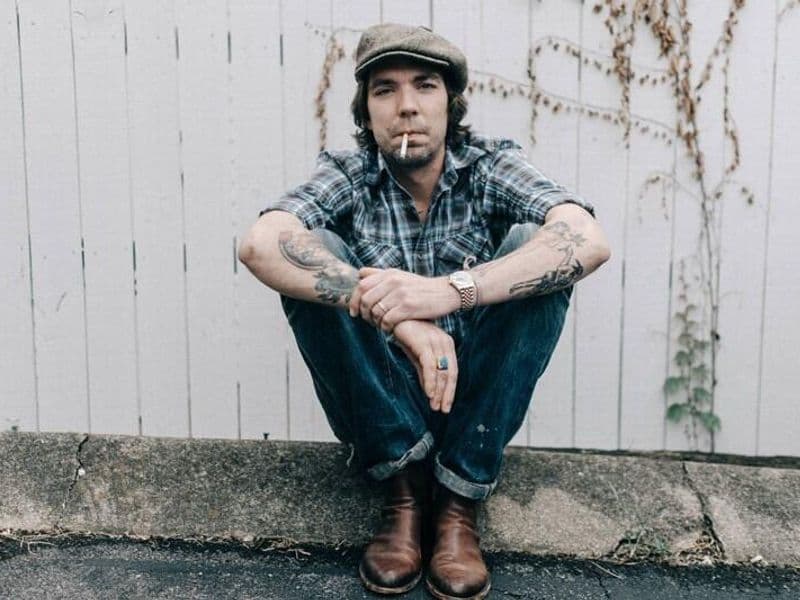
On stage, Earle was a striking presence. Standing nearly 2 meters tall, dressed in vintage suits and playing a fiery fingerstyle he'd picked up from bluesman Mance Lipscomb. He took on the public persona of a world-weary troubadour, living up to his cursed namesake. That would be none other than the self-destructive country-folk genius Townes Van Zandt, who was a friend of his father's. It could be an intense moment straight out of the Old Testament. Always witty enough to toss off lines like, "I haven't changed Bruce Springsteen's formula for girls, cars and sex."
Earle was funny, with a huge obsession for vintage Rolexes and baseball history. His magnetic presence left a lasting impression on those who knew him. He lived the kind of life you'd read about some other country legend living. The son of an entertainer who understood showbiz better than most. In this way Earle embraced and cemented his own myth both on and off stage. He shared tragicomic stories about his teenage heroin overdoses and bar fights that cost him teeth.
He managed to outdo folkie Steve Earle. He was poised to become the first solo superstar of the roots music genre that had come to be known as Americana.
But that mask also covered problems that were getting worse. He battled psychological struggles and self-doubt. And of course, like his father, he struggled with addiction. "The fact that I survived my twenties is a miracle," he once said, "and I believe that with all my heart."
As the years went by, Earle's insecurities grew. "There was a huge part of Justin that didn't believe in himself," Jenn Marie says. "He watched the music business change. When his albums [2014 and 2015's Single Mothers and Absent Fathers] came out, he was disappointed they didn't do as well. I think that's where a lot of his darkness, his struggles with substance abuse and addiction, started surfacing in the last few years. He felt like he wasn't good enough."
After writing the songs for The Saint of Lost Causes in 2018, Earle entered rehab. It was a process he'd gone through more than a dozen times, and then he headed straight into the studio. The unusually vulnerable album seemed like a shot at a career comeback, and executives at New West Records were thrilled. But when fall 2019 rolled around, he started drinking again. So much so that bandmates wondered whether they could even finish the tour.
In January 2020, Jenn Marie helped Earle rent an apartment in Nashville, where he could temporarily live alone and focus on a string of musical projects. He kicked off a solo tour in March, only to shut it down after one show, as the pandemic brought concerts nationwide to a halt. Forced into quarantine in Nashville, Earle spiraled.

Earle considered producing a Nashville hip-hop act and was mapping out several future albums.
These included a Billie Holiday tribute with the Preservation Hall Jazz Band and a record of duets with artists like Yasiin Bey (the rapper formerly known as Mos Def) and Brian Fallon of Gaslight Anthem. Earle, along with his manager and close confidant Larry Kusters, started planning a livestream series. In it, he'd chat with guests about his favorite subjects – baseball, Delta blues, and Civil War battles. It would be titled Justin Townes Earle: Misbehaving.
Still, according to friends and family, Earle continued to fight addiction. Although he was only 38, two decades of chemical dependency had taken a toll on his body. On July 21, he was admitted to a Nashville hospital for pneumonia and underwent major lung surgery. According to Jenn Marie, this was the result of the long-term effects of drug and alcohol use. By the time he left the hospital on August 2, his doctor warned him his body wouldn't be able to keep going if he kept drinking. "We thought it would be a wake-up call," Jenn Marie says.
Justin felt differently. "He always told me, 'Earles don't die, we're invincible.'" A few weeks later, Earle was terribly restless. "When can we get back on the road?" he'd say. According to the New York Times, that same day Justin called his father, who told his son, "Don't make me bury you." "I won't," Justin replied.
Earle became just one more victim of the opioid crisis, a subject he wrote about on his final album and spoke about passionately on stage for years.
Then, no one heard from him. When the Nashville police department conducted a welfare check on Sunday afternoon, they found Earle dead in his apartment. A toxicology report showed he died of an accidental overdose from a combination of alcohol and fentanyl-laced cocaine. That was the same deadly opioid responsible for the deaths of Prince and Tom Petty, among many others.
Earle became just one more victim of the opioid crisis, a subject he wrote about on his final album and spoke about passionately on stage for years. "We've been asking people who have addiction problems the wrong questions for a long time," he said in 2018. "We say, 'What's wrong with you?' The problem is, they're in pain. So you don't ask them, 'What's wrong with you.' You ask them, 'Why does it hurt?'"
Earle's death caused an outpouring of grief among fans like Stephen King and Billy Bragg. Steve Earle pays tribute to his son with 'J.T.', an album of his son's songs. "The record is called J.T. because that's what we called him until he was grown."
Earle's early years
In the late seventies, Steve Earle met Carol Ann Hunter at a Nashville bar where she worked. They married in 1981, and Hunter gave birth to Justin a year later. When Justin was four, in 1986, his parents split up. That year, Steve Earle became an unlikely country star with his debut, Guitar Town. One song, "Little Rock 'n' Roller," was a touring musician's promise to his son. "One of these days when you're a little bit older," Steve sang, "you can drive the big bus and everything will be fine."
Justin spent his early childhood with his mother in a rough neighborhood in South Nashville. There he was exposed to drugs and dropped out of school in the eighth grade. Once he dropped out, he started seeing more of his father. He'd tag along on tour with him as a guitar tech.
In the late '90s, Justin joined his first real band, the Swindlers. The band was a collection of kids whose fathers were successful Nashville songwriters and musicians. They were nicknamed "Music Row brats." The Swindlers' headquarters was a studio in the backyard of the Welch family property, known as the Chicken Shack. It was a dusty shed full of recording gear, where Earle and Welch would hang out for hours as teenagers. The boys spent their nights playing their fathers' records and putting their fingers on the spinning vinyl to slow it down and study the instrumentation.

Justin shaped so much of the broader, younger perspective of America's music.
By the time he was a teenager, Justin was writing deeply adult meditations on loneliness and despair. Elements that showed up in "Rogers Park" and "Down on the Lower East Side." As a budding songwriter, Justin was hungry for his father's approval, which didn't come easily early in Justin's career. Once, after the Swindlers finished a show with a newly written original called "Maria," Steve asked Justin about the Elvis Costello song they'd closed with. Over a decade later, Justin was still proud of the unintentional compliment.
As Justin grew as an artist, Steve became more and more one of his son's biggest fans. All of this on a public level, because privately Justin was still seeking his father's approval. "I don't know if he'd ever listened to Harlem River Blues," Justin told a journalist in 2012. "I've gone over [to Steve's house] a few times and found the same, still-shrink-wrapped copy sitting on the counter."
Earle was proud to be an artist in an industry that rarely valued real musicians. On one of his early tours, he was enraged when a stranger insulted a street musician. "We walked past a street musician, and the guy wasn't very good," Poulton recalls. "Someone told him, 'Get a job,' and that's exactly what set Justin off. He felt it was already hard and difficult, what that guy was doing."
For all his wonderful gifts, Justin was never free of his father's shadow. Their complicated relationship ended up becoming one of his most enduring subjects as a songwriter. From 2009's "Mama's Eyes" ("I am my father's son") to 2012's "Am I That Lonely Tonight."

Earle was proud to be an artist in an industry that rarely valued real musicians
By the time Earle released his first album, in 2008, he was 26. He was enjoying the first sustained period of calm in his adult life. He was slowly building a huge fan base. He played, in fact, several hundred shows a year as an acoustic duo with his former Swindlers bandmate, Cory Younts.
Earle loved mentoring younger artists, giving advice that often seemed as much meant for himself as for anyone else. When teenage singer-songwriter Sammy Brue joined Earle for his first national tour, Earle gave him regular lectures about drugs. "He put it in my head that I shouldn't touch that stuff," Brue says. "He wanted to protect me."
Earle was often extremely generous. He'd give his opening acts and bandmates extra cash while on tour. When Earle heard that Fritz had lost a favorite shirt, one he'd originally bought at a Virginia gas station, Earle tracked down the same shirt for him.
This sense of loyalty helped put Earle at the center of a fast-growing roots music revival based in East Nashville.

Within 10 days of the album's release, Earle went back into rehab, postponing the biggest tour of his career. Harlem River Blues nevertheless became his best-selling record, leading to a growing fanbase and Letterman appearances.
After another stint in recovery, Earle was prescribed Suboxone, a drug given to patients countering opioid addictions. By the time he appeared on Letterman for a second time, in February 2012, he looked and sounded like a different singer than the one who'd appeared on the show just a year earlier.
Around this time, Earle burned through many of his closest personal and professional relationships. Collaborators like Younts and Davies had stopped touring with Earle, leaving the singer feeling abandoned.
That same year, he met Jenn Marie Maynard, a high school acquaintance he reconnected with at a show in her hometown of Salt Lake City. Earle fell for her. She was a former athlete who ran a yoga studio and was nearly as tall and charming as he was.
Meanwhile, Justin and Jenn Marie grew tired of Nashville. The couple moved to a remote area on the Northern California coast, which Earle described as "a town full of poor hillbillies who all grow weed." At first, Earle seemed to thrive out West. In California, he read books about the Civil War and spent his mornings walking the couple's dog on the rocky beach.
At the same time, he was still thrilling crowds. Off stage, however, he was struggling with various mental health issues.
In the early years of their marriage, Jenn Marie toured with Justin, and the couple spent their free time on the road hunting for antique shops. Earle spent freely, collecting old maps, rugs, vintage Rolexes and gilded lighters. Jenn Marie had grown familiar with all of Earle's quirky habits.

Earle had long been prescribed medication to help with mental health issues. He had trouble, though, sticking to a stable treatment plan. He'd see several different doctors who gave different diagnoses and often prescribed medication over the phone. In California, Earle stopped taking Suboxone. "That's when his other addictions started coming back," Jenn Marie says. Earle smoked medical-grade weed. According to Jenn, he was often "high from the moment he woke up until he fell asleep. That's just how it worked."

A few years later, Earle would tell Jenn Marie that their seemingly idyllic stint in California had actually been an especially isolating period. He'd drifted from old friends and struggled to write songs without the influence of city life. "He'd always feel lonely, to some degree, even when surrounded by love," Jenn Marie says.
"He was really captivated by the stories and the damage of things and he didn't write happy songs. He didn't really give himself the chance to be surrounded by positivity. He didn't open the door, fully, to that. He was just cracked."
On the West Coast, old friends found it hard to reach Earle. "He's probably gone through 30 iPhones in the last 10 years," Wilkins says. In 2017, Omaha-based musician Mike Mogis was hired to produce Kids in the Street. He then tried calling Earle 10 times. Before one of these scheduled calls, Earle informed Mogis he couldn't talk because he was at Wrigley Field in Chicago. He was watching his beloved team, the Cubs, play in the World Series.
By the time Earle arrived in Omaha to record, he didn't yet know he was going to be a father. The prospect of fatherhood inspired Justin. He later mentioned that if his daughter, Etta, ever wanted to become an artist of any kind, she could drop the "Earle" surname.
But even as he grew closer to his father, Justin still grappled with feelings of inferiority.
Once Etta was born, Earle was overjoyed. By then, Justin and Jenn Marie had moved to Portland, Oregon. Fatherhood helped Justin feel closer to his father. "We talk more lately, it's kind of weird," Steve told Justin shortly before Etta was born.
In his mid-to-late 30s, Earle admitted to those closest to him that he still wasn't ready to fully face his deeper struggles.
In his final years, he reconnected with many of his old friends. When Welch surprised Justin at one of his 2018 shows, in Austin, Earle left the green room and jumped on his old Chicken Shack roommate. After nearly a decade of not playing together, he invited his old collaborator Cory Younts to play on The Saint of Lost Causes. Last spring, he reconnected with several old Nashville friends, including Skylar Wilson.

In Nashville, during his final eight months, Justin spent a lot of time with his mother.
Earle had helped buy her a house earlier in his career. "She always worried about him and loved him to death," Welch says.
Jenn Marie and Etta, whom Justin had nicknamed Etta-belle, visited Justin several times in 2020. The last time the family was together, a few days before Justin's death, Jenn and Justin spent time together. They visited their favorite antique shops and the parks where Justin had played as a child. Among these, his favorite: Nashville's Dragon Park. At the end of their trip, Jenn Marie and Etta got in their car to head to the airport. Justin shouted out the window, "I love you."
The moment will stay etched in Jenn Marie's memory. "I wish I could've just grabbed him and said, 'You're coming home.'" But he wouldn't have come anyway. He would've come up with some excuse to be alone, because that's just how he was."
One last thought
Earle was yet another artist who, despite his talent, drowned in a sea of his own fears. Although he sang, 'Always look the other way', he never applied it to his own thoughts. The truth is his talent was immense. To many, and perhaps to me too, he managed to achieve what he always wanted. To step out of his father's shadow. In closing, I can certainly picture him driving up to heaven in his Champagne Corolla. But the bitterness is great, since he now belongs to that group of musicians who left us too soon. With nothing more to add, I'll leave you to let his magical music carry you away.