

Drapery Band: 'Creating music was born spontaneously.'
Drapery Band open up to us in an exclusive interview with Fuzzy Hound, on the occasion of their album 'Black Loone'.
By Dimitris (Bari) Polyzois
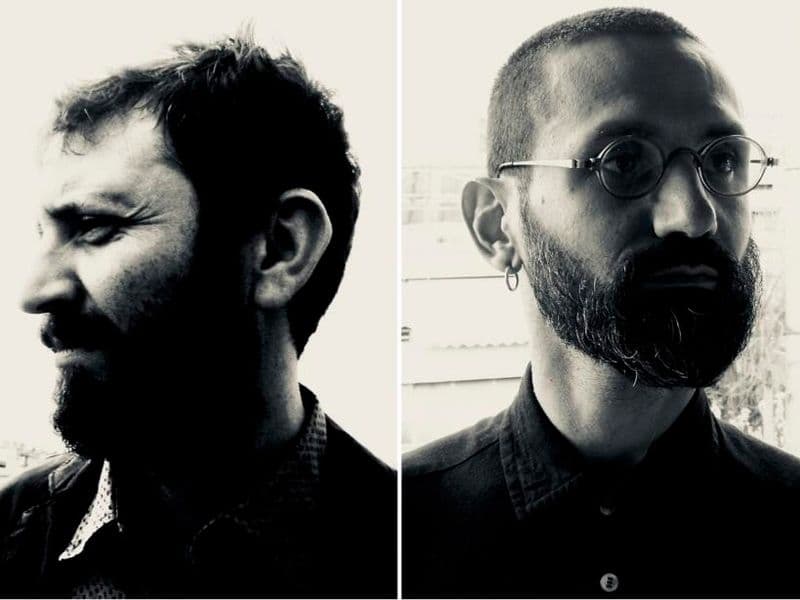
Following 'Black Loone' (released under InnerEar Records – Facebook, Instagram), Drapery Band talk to us in an exclusive interview about their future plans and their philosophy!
Today we welcome Drapery Band to Fuzzy Hound! You've just released your first record, titled 'Black Loone'. What are your current feelings about the album? Your thoughts? Are you happy with this release? Did it achieve its purpose?
Giorgos: 'Seeing it for what it really is, and in the middle of a pandemic, for us at least – on a psychological level – it achieved its purpose. Especially if you consider that as Drapery Band we don't have any "ambitions" beyond creating – as much as our time allows – new music, meaning writing without any timeline or very specific goal, like making the next release a full length instead of an EP, or chasing after some live show, which is tricky both in these covid times and because of technical difficulties, i.e. finding the time and the musicians to deliver our music the way we'd want, without compromises.
Which is of course something we'd really like. Looking back at Black Loone almost a year after its release, we think it captured, in a very honest way, the era in which it was written – gaps and all – and we've already started working on material that seems to differ somewhat from the mood of Black Loone.’
Tell us a bit about this work and what sparked it. When did you compose the tracks and on what basis did you pick them for the album? Also, where did the title 'Black Loone' come from?
Nikos: 'The spark to start making music came spontaneously, on a balcony in Thessaloniki around 2016. While our conversations with Giorgos revolved solely around musical instruments and various genres, the idea came up of getting together and playing music without the record itself being the goal. I could say the idea of making a record wasn't even a thought lurking in the back of our minds. We've been friends for years, sharing common listening tastes and an appetite for music. That appetite for making music, and jotting down ideas, is what's brought us to talking about this record now. In 2017 we started gathering ideas without necessarily wanting to turn them into a complete whole that would be called a record. In 2018, once we saw there was chemistry and an abundance of ideas flowing effortlessly and without much discussion, we moved on to developing the tracks, rejecting some and deciding that others would make up an EP. At the end of 2019 and the start of 2020 there was a rapid development phase, during which the EP was finished in its current form.
The title of the EP is Black Loone, or in Greek, Μαύρο Λούνη. My village, Pelasgia, is in Eastern Fthiotida. There, when you find yourself on a beach with muddy waters, you say the phrase "here it's loone." Drawing on that expression, and on the love we both have for that village, we decided to make this particular play on words the title of the EP, as well as the title of the fifth track. '
I understand you also did some composing remotely? How did you end up choosing that?
Giorgos: 'Quite a few things on this record happened in a rather "unorthodox" way, in a good sense. At first we both lived in Thessaloniki, but Nikos had to move to Athens for personal reasons. By that point, though, we'd already laid the groundwork for our collaboration. We've been friends for years, and we just said what was obvious to us at that point — that we'd find a way to make it work. That meant endless wetransfers, meetups in Pelasgia, Thessaloniki, Nea Skioni and Athens (mostly just to hang out). I think our music would be different if everything were "ironed out" and "neatly arranged," but life itself is never like that. What I mean, I guess, is that all this actually makes the creative process more multifaceted in the end — we probably enjoy it more, it doesn't cost us creatively, not compared to what the distance between us costs us on a personal level.'
Did it work out, in the end? On the same level as if it had all been done 100% in person? Could this be a way we'll see recordings made in the future? Is it an evolution?
Nikos: 'For us it worked, and I believe it will keep working. We're neither the first nor the last to play and record this way. Of course, given the first chance, we try to erase the distance between us and meet up in person, not just to make music and swap ideas but also for the impact we have on each other's lives.
Recordings like this existed in the past too, even more so now that our way of life has changed, and it looks like we'll keep being stuck behind a camera, a microphone and some software.
I hope, though, that we use all these means in such a way that they don't wipe out face-to-face contact. '
Regarding your style, you've mentioned the term post-romantic indie punk. Tell us more about that.
Giorgos: 'Okay, that's a definition — really more of a self-mockery, because there's no more obvious and at the same time more clichéd question you can ask a musician, and Nikos and I said that if such a genre officially existed, it'd be nice to consider ourselves its representatives in Greece. So, self-mockingly, we slapped that term onto our own "bio" just to put the matter to rest. Anyway, we're all postmodernists now, apparently.'
You've made something rather groundbreaking. Were you influenced by the broader music scene in Greece? What's your take, more broadly, on the contemporary music scene in Greece?
Nikos: 'Our influences are varied. Mostly subconsciously, after enough hours of music as listeners, we might get influenced without meaning to, but I'd say we're influenced even by music we don't listen to. For instance, you won't find any Metal elements in the record. The fact that we don't use Metal elements is itself an influence too (hehehehe).
As for the contemporary music scene in Greece, I don't really have anything to comment on since I'm not big on labels, unless they're completely distinct. '
Tell me a bit about your influences. Which artists or bands do you think 'Black Loone' owes its existence to?
Giorgos: 'Nikos and I pretty much always listened to the same music, and naturally influenced each other. It's kind of pointless to dissect your own music just to pin down your influences. Everything you've ever listened to has played its part. Overall we've listened to a lot of post-rock in our lives so far, a lot of indie, a lot of jazz on Nikos' side, rebetiko. But in a sense we might've been influenced by Metal too, precisely because there's no Metal element at all in our music — and that itself is a form of influence, choosing not to include it at all.'
Lyrically, you've mostly gone for an instrumental profile. First of all, how did that come about? Are there stories behind the tracks and the lyrics?
Nikos: 'The lyrical side naturally takes a back seat, in the sense that what grabs your attention first is the composition of a melody, and only afterwards do you pay attention to the lyrics. That's how we are as listeners too. The music, the composition of a melody, will grab us first, and only afterwards will we go looking to see what the lyrics are trying to say. We don't get too deep into analyzing what the meaning of the lyrics should be. We marry the mood of the music with the lyrics.
There could be stories and real events behind the tracks and lyrics, but then again there might not be. We leave that to the listeners' imagination, since there's no exact translation. Everyone experiences it differently.
The only sure thing is that the lyrics are written by Giorgos (hehehehehe)!'
Do you follow any particular method when composing?
Giorgos: 'The method, because of the distance, pretty much picks itself for us. We exchange files, i.e. ideas, whether shaped or not, small or big, which can either be worked on when we're together, or we come up with ideas together at the same time when we're together and then work on them "from a distance" afterwards. In short, we don't follow any protocol. The way we work changes and will keep changing and evolving, and naturally, along with it, the result will change too — meaning the music.'

The pandemic situation affected a lot of artists. How did you handle it?
Nikos: 'Pretty much right at the start of the pandemic was when we picked the tracks back up and started working more seriously on the mixes. That's when the "material" was officially sent to the record label inner ear to be evaluated, and we eventually agreed on releasing the record.
The pandemic definitely changed our daily lives, as it did for everyone. Sometimes we think of it as an experience testing our limits, both with other people and with ourselves. It's a chance to see what we'll keep and what we'll toss out from our old lives. '
At this point the situation has clearly improved. Is there a live performance in the works? Also, do you have a follow-up to 'Black Loone' in the pipeline? Plans for the future?
Giorgos: 'Unfortunately, even though it's something we'd really like, there's no scheduled live show due to a bunch of factors, and for us, from the start, writing has always been the priority, and whatever time is left over goes there. We have quite a bit of material we're working through, but we still can't talk about a follow-up, or even whether it'll be an EP or a full length album. For now, and given the situation around us, we're setting small, nearby goals that will lead to the bigger ones — a new complete release and a live show, but the way we've actually pictured it.'
Guys, thank you so much for being here, and we wish you every success in whatever you do! You can wrap up our conversation however you like!
'Thank you very much for the interview. Until next time!'