


Plini: "Satch gave me huge inspiration."
The Australian instrumental guitarist Plini talks about the influence of Joe Satriani, the evolution on his new album – as well as the incident with Doja Cat.
By Dimitris (Bari) Polyzois
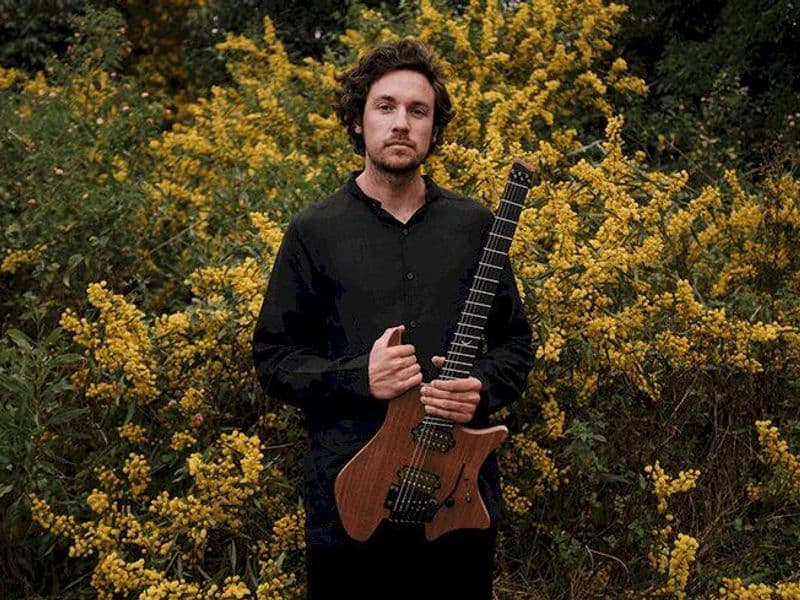
As the man behind one of the most memorable instrumental records of recent years, it would be fair to say a lot was expected from Plini's return at the end of last month. Arriving four years later, Impulse Voices took shape. The Australian virtuoso's exceptional tone, tasteful melodies and exotic gravity once again pushed the boundaries of modern guitar playing and - most importantly of all - with a unique sense of character and identity. As it turns out, most of the material came together early in the year…
"Some of the tracks are old. Maybe even five years old. In terms of the initial ideas," Plini explains. "When I was planning the album, I thought I was closer to finishing it than I actually was. I had eight song parts. In the end, it was really only 30 seconds worth keeping and then four minutes of variations that were completely pointless. So most of the hard work happened early this year, the first few months, and it's still fresh…"
Most of the work is still fresh
The album was mixed and co-produced by Simon Grove, who also played bass. With Chris Allison on drums and guest contributions from Dave Mackay on piano and composition. John Waugh on saxophone, Amy Turk on electroacoustic harp. In addition, production was handled by Devesh Dayal (Skyharbor) and Aleksandra Djelmash.
"It's got some of the heaviest distorted stuff I've ever done," Plini continues. "But maybe the cleaner parts stand out more in terms of surprise. The world I live in tends to be heavy guitar. I think from listening more and more in recent years, I've found more things to put into the tracks. And some of that maybe hasn't been explored as much in progressive metal."
Speaking of which – the second single, Papelillo, opens with some really sweet sixths and double stops, almost in a style like Jeff Beck…
"This song started as the first riff along with the bass. The double stops were kind of a vocal commentary. My original plan was to turn it into a Snarky Puppy kind of thing, with a long and weird solo in the middle," Plini mentions.
"But then when I went to record it properly, I decided to leave the bassline alone. That's why the part ended up so simple. Probably one of the easiest things I can play. And I like doing things like that, because I can imagine that when we play live, I won't be doing anything. I'll have an awesome band playing this cool riff and I'll just be using one finger for that section!"
The song Perfume starts with some very interesting staccato pentatonic ideas before exploring more vocal-style top-line melodies in ways similar to Joe Satriani…
"That's something I loved about Satch's playing. He'll go for the simplest melody and the phrasing will be absolutely perfect. The way the note is placed in relation to the rhythm, always slightly late or early, and his vibrato is always gorgeous."
"I feel like he doesn't really take notes, he sort of squeezes them, wringing his guitar almost like a lemon. Joe Satriani is a huge influence on me. He inspires me enormously, so it's really nice when people tell me they can hear it in there."
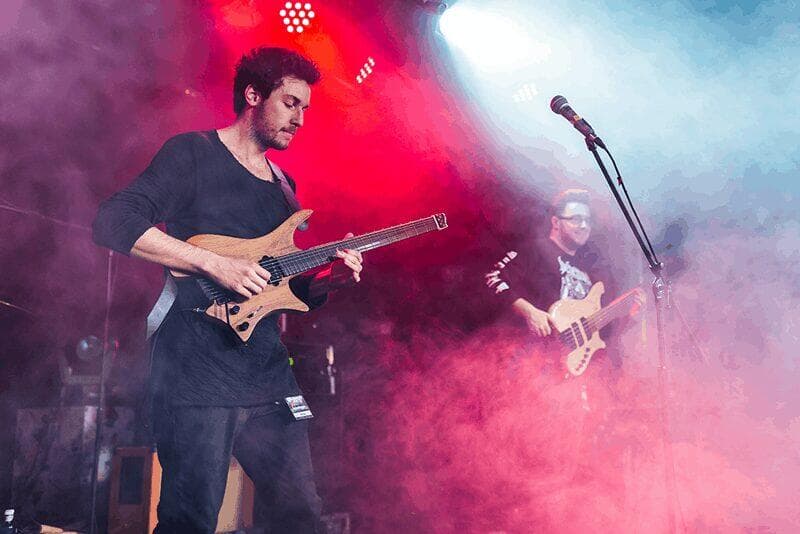
There are a lot of strange chords throughout the album. What's your approach to finding the right ones?
"I'm experimenting more and more with extended chord voicings. If I have a part that uses some progression, say just two chords, I'll first play the simple version and start building things up. Then I'll add the original notes for something more abstract…
"I'm experimenting more and more with extended chord voicings"
"On an E chord, if you had E, B and G - maybe if you also add a C# there and a D#. Then take out the E and B, and what's left is a G with the C# and D#... which doesn't really seem to relate to E minor anymore, but it's the spicy element of the sound. I do it with total faith in the trial and error method."
There are some really dense sound effects on the track Pan. It also contains some really beautiful, almost fantastical, atmospheric textures…
"That's a bit more of that Satch inspiration, maybe one of the more obvious ones. I imagined being bald and wearing sunglasses to record all these melodies! Something I do on a lot of songs is tripling up the main melody. One in the middle and one octave left and right."
"For a change, this was the one guitar line coming through the center and some fuzz pedals with octaves up and down, along with a stereo delay to give it width. It ended up being three octaves, with fuzz, without fuzz, and a small dose of delay and reverb."
Glass Bead Game, which closes the album, is an excellent example of your wide interval lines, which occasionally give a nod to the wonderful Allan Holdsworth…
"I wouldn't necessarily call him a big influence, only because I have no idea what he was playing at any given moment. I'd definitely say he's a huge inspiration though. I love his sounds, phrasing and tone. There's another guy from Boston called Tim Miller who I'm a big fan of. He has really good educational material about widening your phrases, skipping strings, missing notes out of a scale to make a new scale…" Plini points out.
"It's all stuff I've been digesting these past few years to think more outside the box. When I wrote melodies a few years back, if I needed to get from one note to another, I'd kind of follow the pentatonic scale to get there. Now lately I've tried to skip most of it, go really far out and then come back or something (laughs)."
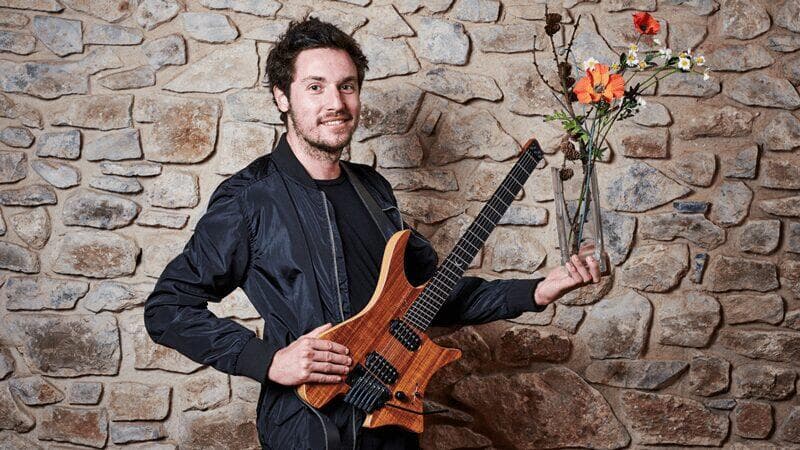
Tell us about the speed we hear on the new album. We're guessing your Strandberg guitar and the signature Neural DSP Archetype plugin did their job well…
"As far as I know, the plugin captures a fantastic sound quality. I tried it out and sent it to Simon [Grove] for mixing with all my settings.
I think it kept the drives and cleans almost the same, maybe just tweaking the delay's EQ or the resonance. Depending on the song, the rhythm tones are from the 5150 and the JCM800. Along with, of course, a bunch of studio tricks and tools. It was using the add-on for most of the album, except for the rhythms, that made the difference…
"And I used the latest version of my signature Strandberg. The new version has a new neck. Otherwise it's pretty much the same as what I've had for the past two years. I have a signature set of pickups. For a few of the simpler things, I borrowed my friend Jake Howsam Lowe's seven-string Aristides for the recording. But 95% of this album was just the Strandberg."
There's a lot to be said for the quality your plugin offers…
"Yeah! It was pretty easy because the plugin is that good. I guess it was designed exactly the way I wanted it to sound! My demos ended up sounding closer to a finished album, much more than ever before, and that saved a lot of time when it came to translating things into a mix."
"My last EP had quite a few tweaks to the guitar tones. This was really easy... I want it to sound like this, and it does!"
Are there any techniques or exercises you've been doing lately that influenced your composing?
"On the album, I guess one thing I was working on was composing even longer passages - ideas in sixteenth notes that last a fair amount of time, going back and forth and up and down without being too repetitive. Or groups of four notes at a time. Instead, I tried to string together odd groupings of notes, so I could go for two bars with that wall of sound without feeling like a pattern was repeating over and over…"
"I did things like seven notes, then five, three or six - just going in different directions. That came from sitting around and putting in the hours and getting comfortable playing across the scales. It's something I'd recommend to any guitarist looking for new phrases. Take the shapes you know and apply odd numbers to them."
You recently made headlines after the track Handmade Cities was used by American pop star Doja Cat for her performance at the MTV EMA. After the initial surprise, that must have felt like a compliment…
"I'm pretty much floored on every level. Some people sent me this link saying they saw Handmade Cities might be used in this performance, and I listened and thought, yeah, that sounds like this song. That was weird! It was a strange context for something that sounds that similar to be used, too similar to be a coincidence.
"I made a comment on Twitter, without blaming anyone for anything. Just because I thought it was funny. Then this whole thing happened.
"The best part of all this is that I woke up one day to a series of voice messages from Doja Cat in my DMs, saying sorry and that she wished she'd known about all this and wished they could have credited me properly."
I guess the fans really did all the work and had all the outrage on my behalf. I was just sitting there wondering what was going on and finding it hilarious." Here Plini couldn't hold back his laughter.
So, if you don't mind us asking, what happened in the end?
"Turns out the Music Director of that show was inspired by our music and some of the band knew about it beforehand. He thought it was cool, that riff. It must have been an honest mistake. Maybe he didn't realize it could be an issue in some way. And then it eventually reached Doja Cat…
"The best part of all this is that I woke up one day to a series of voice messages from her in my DMs, saying sorry and that she wished she'd known about all this and wished they could have credited me properly. She also complimented my song and thanked me for being so cool about it.
"I thought about it and realized it was the strangest thing that's happened to me in my career so far. One of the biggest pop stars sending me an apology because someone somehow grabbed my music for her live performance. Life is so strange (laughs). As for me, it's a great story." Here Plini appears very relaxed.
You can find more music from Plini on the musician's official channels:
You can follow the band through their official social media, to keep up with more news: