


Alberto Lombardi in a musical chat
Alberto Lombardi in an in-depth conversation about Motown, Taylor guitars and much more. Alberto Lombardi worked as a professional electric guitarist for more than two decades before turning to acoustic as his primary form of musical expression several years ago.
By Dimitris (Bari) Polyzois
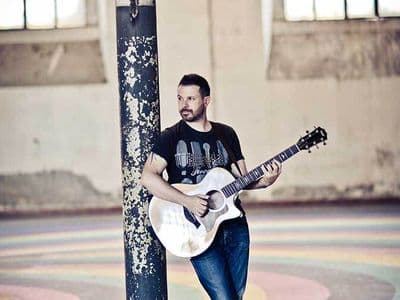
As for what led him to unplug? Tommy Emmanuel.
"What I find so appealing about acoustic fingerstyle playing is that it acts as a bridge for us electric kids. It's a style that combines both worlds," explains Lombardi. "When I heard Tommy, I felt something really special. From there I went to Chet Atkins and Jerry Reed and all these wonderful acoustic players. But I needed Tommy as a bridge."
In 2016, Lombardi released his first acoustic album, Birds. It was a collection of original pieces, alongside covers of Italian songs ("Nel Blu Dipinto Di Blu", also known as "Volare"). There were also several American and British pieces ("Georgia on My Mind," The Beatles' "Come Together").
Influenced by Emmanuel, Lombardi's playing featured an Atkins-based approach, accented by inventive harmonic and melodic twists. All of it with a healthy dose of rock 'n' roll.
"When I heard Tommy, I felt something really special."
"I come from the '80s and '90s and we all had that craze for technique back then. We wanted to be fast like Steve Vai, Eddie Van Halen and Yngwie Malmsteen."
What's your go-to acoustic guitar for fingerstyle?
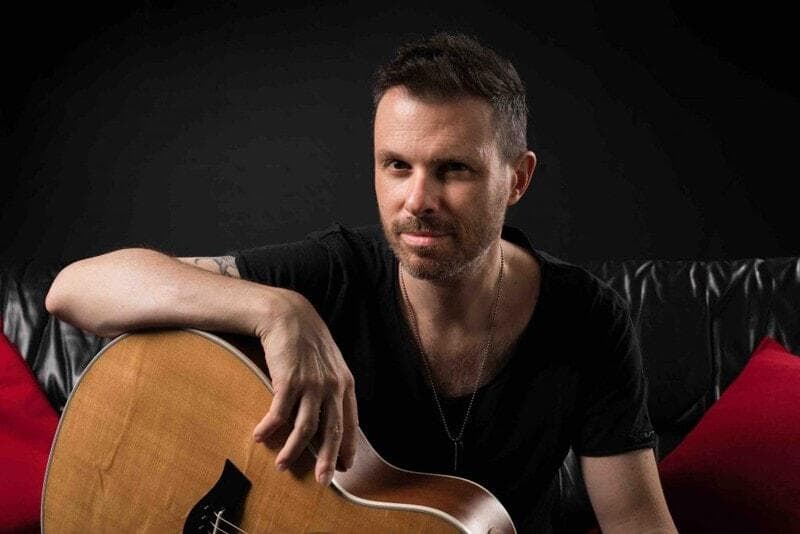
"When I started exploring fingerstyle, four or five years ago, I developed a relationship with Taylor. And so I built up my little collection, which is three Taylors. My main one is the 515, which is a jumbo I bought back in the '90s, when I was studying at Musicians Institute in Los Angeles. It has a very balanced tone with a crisp top end and even though it's a jumbo, it's not weird.
In the studio it's a great guitar, but I can't take it around – it's 30 years old and I don't want to break it. So I have a newer Taylor, a 412, and I also have a 612, which is an all-maple guitar, that I use a lot more. The 12s, they call them Grand Concert models. They're smaller instruments, so fingerstyle works really well with them.
It's interesting that your main recording guitar is the 515. Given its size, you wouldn't think of using that model for fingerpicking.
"It's not exactly suited for fingerpicking, because jumbos usually have a lot of bass. But being a Taylor, it's also crisp, which balances out the body size. Those two things work perfectly together for fingerpicking. But for live performance it's a bit more complicated. The 515 is a really big guitar and I'm a small guy. So I prefer the Grand Concert models on stage."
For about 25 years you played electric guitar. Would you say it was difficult adjusting to acoustic?
"Absolutely. When I first approached fingerstyle guitar, I tried Tommy Emmanuel's version of "Classical Gas." It was still pretty close to what I was already playing. So I said, "Yeah, I can do this." But then I tried the boom-chick stuff, like "Borsalino," and some Chet Atkins pieces. Those were so hard and completely different from what I was used to playing.
It's probably easier to make that transition if you have classical training, which I don't. That's why I had to start from scratch, until I got the alternating bass and all that stuff down. It was hard at first."
I read that the first acoustic music Stefan Grossman heard from you was your cover of "Volare." That song has become a calling card for Alberto Lombardi. It features a lot of the techniques you're known for, like Atkins-style alternating bass, rich and intricate harmonic structures, and artificial harmonics.
Yeah. I think one of the things I really enjoy is arranging a piece for acoustic guitar. So I work out drum parts for the drummer or bass lines for the bass. And I do it all by myself on one guitar from the comfort of my couch. And without a singer yelling at me because maybe he doesn't like the piano part.
For "Volare" specifically, there's a version of that song that the Italian singer [Domenico] Modugno did on The Ed Sullivan Show with an orchestra, and there's this beautiful Hammond organ. I tried to recreate that using harmonics. And at the start, I do a little bass piece to fill out the harmony. Those are the kinds of things I really like doing. That way, I make it more interesting and give it more color, I'd say.
For your new composition, Home, you went back to electric. What were your main instruments in the studio?
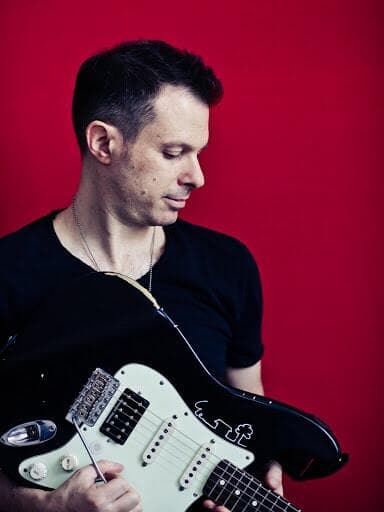
Home is a blues-rock record that really reflects my influences. The Eagles, David Gilmour and Sting. I'm a big Sting fan. And people tend to tell me I sing a bit like him. I'm not as good as he is, but some vocal elements are maybe similar. For guitars, I had two Strats. One is a Custom Shop relic and the other is an old Mexican Strat that I completely modified with Custom Shop parts. I also have a new B&G electric guitar – it's called Little Sister – that I'm really excited about and use a lot. Mostly, I played the Stratocasters.
You're a Fender guy when it comes to electrics. You've even created a live show celebrating famous Stratocaster players.
Yeah. It's a show I tour where I play the music of great players associated with the Stratocaster, like Jimi Hendrix and Stevie Ray Vaughan and David Gilmour and Jeff Beck. That's something I'm trying to do more and more because I love playing that kind of music. Just like I love playing my own music on electric and acoustic guitar.
To wrap up, could you point out what you love most about the acoustic guitar?
I love that it's a complete, self-contained instrument. And I think it has a really communicative tone. You can get so much expression out of it and paint the whole picture. Of course, the electric is also an expressive instrument, but when I play it I want other musicians with me, and that's a different kind of thing. But with acoustic, you can do it all by yourself. I think that's what I love most about it.